Stranded at sea
Not Without HopeStranded at sea is the prolonged condition of being cut off from shore, navigation, and immediate assistance while remaining exposed to the sea’s physical forces. In the account of Nick Schuyler’s ordeal, it begins when the fishing boat overturns and becomes the men’s only visible platform, but its meaning changes as the hours pass: the hull offers flotation without safety, rescue aircraft pass without seeing them, and survival depends on preserving heat, energy, judgment, and hope.
Creation of the Stranded State
The condition was produced by a specific chain of decisions and mechanical failures. Marquis Cooper was driving Marquis Cooper’s fishing boat while Nick Schuyler sat beside him on the captain’s bench. When the anchor would not come free, Will Bleakley and Corey Smith pulled from the bow while Marquis maneuvered the boat over the anchor. After roughly half an hour, the anchor still held. The same problem had occurred on the previous week’s trip, when the line had eventually been cut and a replacement anchor and rope had cost Marquis Cooper two hundred dollars. Determined not to lose another anchor, he tightened the line and gunned the motor.
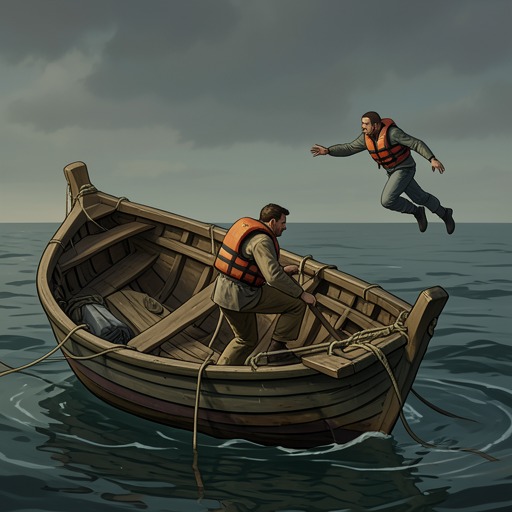
The anchor blades apparently dug in more deeply. The stern squatted, water poured into the boat, the bow rose, and the vessel listed to port. There was no time for a Mayday call. Nick Schuyler grabbed the starboard railing and was thrown into the water as the boat rolled. The Florida Fish and Wildlife Conservation Commission later identified three connected causes: the anchor line had been tied improperly to an eye bracket on the port side of the transom, the motor had been throttled forward to pull the anchor free, and insufficient slack allowed the stern to submerge and the boat to capsize. The stranded state therefore was not simply the result of rough weather; it emerged from the interaction of weather, equipment arrangement, and an attempt to overcome a fixed anchor with engine power.
The Hull as Refuge and Prison
After the capsizing, the men first believed that releasing the line would solve the problem. They drifted the boat to create a small amount of slack, then Will Bleakley and Marquis Cooper cut the rope at the propeller. The stern rose slightly, but the boat did not become recoverable. Corey Smith and Nick Schuyler lay across the stern, kicked downward, and pulled with their arms, hoping a wave would roll beneath the hull. Marquis Cooper and Will Bleakley tried pulling near the front and pushing upward from the starboard side. The submerged center console acted as a resistant rudder, denying them leverage; the boat did not come close to righting itself.
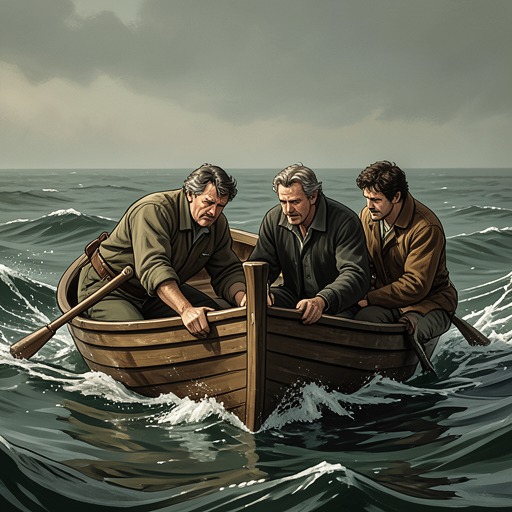
The overturned hull became the men’s fixed point in an otherwise limitless environment. They could cling to it, rest on its keel, and use it as a platform, but waves repeatedly threw them away from it. During one sustained assault, giant waves battered the hull for about twenty minutes, flinging all four men out of reach and forcing them to scramble back. Nick Schuyler was knocked roughly ten feet away several times and screamed as he tried to remain connected to the boat. The sea made the hull necessary while continually demonstrating that it could not guarantee possession of it.
The absence of reliable orientation intensified the confinement. Nick Schuyler had no idea whether the drifting boat was near the Bahamas, Cuba, Texas, or only a mile from the place of the capsizing. He searched for a buoy because a stationary object might have offered something to cling to, but there were no buoys in sight. The overturned boat was also difficult for rescuers to see: in heaving seas, searchers might find only a fingernail of white hull amid hundreds of thousands of whitecaps. The boat had sent no distress signal and apparently carried no emergency position-indicating radio beacon, a device that could have transmitted a unique satellite signal and the vessel’s location. The stranded state was thus geographic as well as physical: the survivors could see the sea, but neither they nor the searchers possessed a dependable position within it.
Physiological and Psychological Deterioration
The sea progressively converted exposure into bodily crisis. Swallowing salt water could produce a poisonous sodium imbalance, draw water out of cells, and lead to delirium, seizures, heart failure, and death by dehydration. Cold exposure created a second lethal process. In water around sixty-five degrees, an average twenty-five-year-old man might remain functional for about 9.9 hours and survive for about fifteen hours, while a fifty-year-old man might remain functional for 11.6 hours and survive for 17.6 hours. Greater fitness did not necessarily protect the younger men: additional muscle could reduce flotation and demand more effort to remain above water, while body fat could provide insulation and buoyancy.
The men’s changing behavior reflected these processes rather than a simple decision to give up. Marquis Cooper swallowed substantial amounts of salt water, gagged, dry-heaved, and shivered constantly. His answers to repeated calls of “Coop?” grew slower, and he began to slur and ramble. Around five on Sunday morning, Corey Smith developed similar symptoms. He became unresponsive until Nick Schuyler and Will Bleakley called his name repeatedly, then suddenly displayed desperate physical energy, pulling at Marquis Cooper’s legs and trying to climb onto the hull. His face looked angry and unfamiliar. He made repeated attempts for ten or fifteen seconds, then went limp before trying again. Nick Schuyler recognized that the cold had altered him and that the man acting violently was not the Corey Smith known to his friends.
The emotional condition of being stranded was marked by oscillation rather than a steady progression from hope to despair. Nick Schuyler repeatedly imagined rescue, land, or a break in the weather, then watched helicopters and planes depart without seeing the survivors. He described his thoughts as a series of what-ifs, joined to prayer, frustration, and uncertainty. By the time darkness approached, he believed that three men were gone and that his own death was only a matter of time. He was starving, severely dehydrated, and nearly unable to keep his eyes open after almost forty hours awake and more than twenty-four hours in the water. Yet even at that point, the absence of alternatives forced continuation: he returned to the boat because, if death came, he wanted to avoid drowning and remain on the hull long enough for starvation or dehydration to be the final danger.
Waiting, Choosing, and Enduring
The stranded state required repeated decisions under incomplete information. Nick Schuyler considered swimming toward a bright city-like glow that he thought might be land, but he judged himself too weak to make the attempt. The overturned boat had survived the pounding waves, and although it seemed to be settling lower, he decided that remaining with it offered the better chance. He worried that an opening beneath the fish tank might admit water and pull the hull down, but the smaller, more predictable swells made waiting seem possible. After a helicopter circled at night, he used his cell phone camera as a signal, flashing it, canceling it, and repeating the process at five-second intervals while the phosphorescent water lit up around him. The aircraft moved away, but he would not stop trying.
Endurance became an exercise in conserving what little remained. Nick Schuyler kept his arms and legs tight against his body, lowered his chin into his clothing, and breathed inside his jacket, sweatshirt, and T-shirt to preserve warmth. His legs were cut and bleeding, his buttocks were torn from sitting on the keel, his hands were freezing inside shredded gloves, and his body was covered with scrapes, contusions, and bruises. He rinsed salt water in his mouth for moisture even though it could not relieve the dehydration. The sea reduced survival to small bodily calculations: how to sit, how to breathe, when to signal, whether to move, and how to remain awake.
Rescue and Meaning
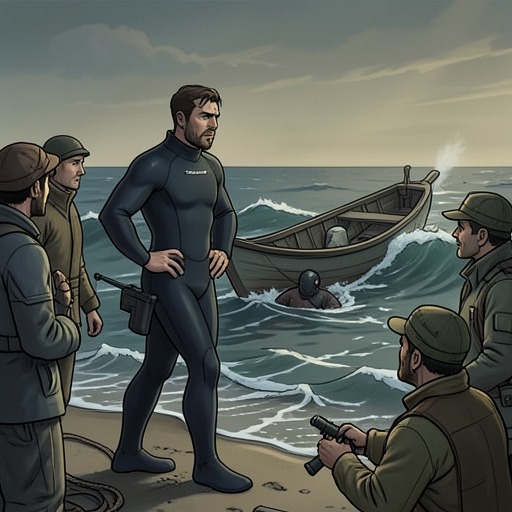
When rescue finally came, Nick Schuyler had floated almost thirty-five miles from the overturned boat. The rescue crew found him severely compromised rather than restored: his temperature was 89.5 degrees instead of the normal 98.6, his breathing was labored, his lips were turning blue, his skin was cool and clammy, and he appeared to be entering the early stages of shock. He knew his name, location, and the month, but could not immediately remember the president of the United States. After being dried, stripped of wet clothing, placed in Coast Guard coveralls, wrapped in wool blankets, and given oversized sandals, he was hoisted from USCGC Tornado to a helicopter for transport to Tampa General Hospital.
The deaths of Marquis Cooper, Corey Smith, and Will Bleakley gave the stranded state its lasting moral force. Dr. Mark Rumbak rejected the idea that the three men had simply surrendered. Hypothermia could produce delirium, falling potassium levels, and damage to the heart’s cell membranes until the heart could no longer contract; confusion and physiological collapse, rather than a free decision to abandon life, explained their disappearance. Nick Schuyler’s survival consequently became inseparable from survivor’s guilt and from the question of whether different choices could have changed the outcome.
In retrospect, Nick Schuyler identified preventable vulnerabilities: the crew should have been prepared to send a distress signal, communicated their precise location, carried better flares and flashlights, and worn life jackets or known where they were stored. He also wondered whether giving Will Bleakley his winter jacket or sweatshirt might have prolonged Will’s life, while acknowledging that doing so might have endangered Nick as well. Stranded at sea therefore names more than a stretch of time before rescue. It is the threshold between ordinary confidence and radical dependence, where a boat becomes a refuge, the body becomes a diminishing resource, and survival can remain both an achievement and a source of grief.